Does homeowners insurance cover water damage? It depends on where the water came from and how it got in. This guide sums up what the Insurance Information Institute (Triple-I) and FEMA say, plus what to photograph before cleanup. It is general information, not insurance or legal advice.
Does homeowners insurance cover water damage? The short answer
Triple-I lists water that escapes your plumbing by accident among the risks a standard policy covers. It also says flood, typical sewer backups and damage from lack of maintenance are not covered.
Your own policy wording matters most. Your insurance company decides what your policy covers. Your adjuster can explain your coverage. An adjuster is the person your insurer assigns to look at the damage.
The cause of the water is the first question. Before you call your insurer, try to answer these:
- Did the water show up suddenly, like a pipe that burst?
- Did it come from inside your plumbing, or from outside, like rising floodwater or a backed-up sewer?
- Was there a leak you knew about and left alone?
Two words in your policy help here. A peril is an event the policy names, like fire. An exclusion is something the policy leaves out, like flood.
The insurance sources in this guide are national. In Scottsdale or anywhere else in Arizona, read your own policy for the details.
No one can promise what your insurer will pay. Be careful with anyone who does.
Burst pipes and leaking pipes
Triple-I lists accidental discharge or overflow of water from within a plumbing system among the perils a standard policy covers. It also says damage from lack of maintenance is not covered. So a sudden burst and a drip ignored for months can get different answers.
In plain words, accidental discharge means water that escapes your pipes or fixtures by surprise. A supply line that splits under a sink is one picture of it. A pipe that bursts inside a wall is another. Your insurer decides if your event fits.
The pipe and the damage are two separate questions. Ask your insurer if the policy pays for the water damage. Then ask if it pays to fix the part that failed. The answers can differ.
Toilet overflows depend on the cause too. If a supply line or fill valve failed, the water came from your plumbing. If the sewer line backed up, ask your insurer if it counts as a sewer backup. Sewer backups have their own rules, explained below.
Small leaks are worth fixing now. Triple-I says policies do not cover damage due to lack of maintenance. Keep the plumber’s bill as proof the leak was fixed.
If a pipe has already burst, close the water valve first. The plumber fixes the pipe. Then the wet materials get dried. Read about burst pipe water damage to see what cleanup and drying usually involve.
Is a slab leak covered by insurance?
Ask your insurer, because no single rule fits every policy. The repair of the pipe and the water damage it caused can be treated differently.
A slab leak is a leak in a water pipe that runs under the concrete slab your house sits on. The pipe is hidden, so a leak can run for a while before anyone sees damage.
When you call your insurer or agent, ask:
- Does my policy pay for water damage from a slab leak?
- Does it pay to find the leak and reach the pipe?
- Does it pay to fix the pipe itself?
- Is there a dollar limit for this kind of loss?
Write down who you spoke with, the date and what they said. Ask for anything important in writing.
A leak left alone can look like a lack of upkeep. Triple-I says policies do not cover damage due to lack of maintenance. If you think you have a leak, get it checked soon.
Does homeowners insurance cover sewer backup?
Not under a typical homeowners policy, according to Triple-I. Triple-I adds that flood insurance does not cover sewer backups either.
A sewer backup is wastewater that comes up into your home through a floor drain, toilet or tub. Stay out of it, and keep kids and pets away.
Ask your agent two things, ideally before you ever need them:
- Does my policy include sewer backup coverage?
- If not, can it be added, and what would it cost?
The EPA says that if damage came from sewage or other contaminated water, call a professional experienced with that type of damage. Read more about sewage cleanup and what it usually involves.
Is flood damage covered? Usually not
Most homeowners and renters insurance policies do not cover flood damage, according to FEMA’s National Flood Insurance Program. Triple-I also says flood is excluded under standard policies.
Flood coverage comes from a separate flood policy. Ask your agent about one through the National Flood Insurance Program (NFIP) or a private insurer.
Flash floods happen here too. The National Weather Service in Phoenix lists flash floods among common monsoon hazards.
FEMA says just 1 inch of floodwater can cause roughly $25,000 of damage to a home. FEMA notes that costs vary by location.
Storm water can also come in through a damaged roof. Ask your insurer how your policy treats a roof leak and how it treats rising water.
Is mold covered?
Triple-I says homeowners policies do not cover damage due to lack of maintenance, mold or infestation. If mold follows a sudden leak, ask your insurer how your policy treats it.
Mold grows where there is moisture. The EPA says the key to mold control is moisture control. So the sooner drying starts, the better.
Waiting gives mold more time to grow. Report the leak early, and start drying once you have photos.
Search your policy for the words “mold” and “fungi” to see what it says. If the wording is unclear, ask your agent.
How to file a water damage claim: what to document first
Take photos and video of the damage before anything is moved, cleaned or thrown away. Then call your insurer or agent to report the damage and ask what your policy covers.
- Stay safe. If water is near outlets, cords or the electrical panel, stay out of it.
- Stop the water. Close the valve at the fixture, or the main shut-off for the house.
- Take photos and video. Start wide, then go close. Show the source, the water line on walls, wet floors and damaged items.
- List damaged items. Write what each item is, about when you bought it and what it may cost to replace. Add receipts if you have them.
- Call your insurer or agent. Report the damage and ask what your policy covers. Write down the claim number, the person’s name and the date.
- Keep every receipt. Plumber bills, fans you buy, a night in a hotel. Ask your insurer which of these it may repay.
- Hold on to damaged items. Ask your adjuster before you throw out big items. If something must go for safety, photograph it first.
Photos first, then drying. The EPA says to dry water-damaged areas and items within 24 to 48 hours to prevent mold growth. Paperwork should not hold up drying.
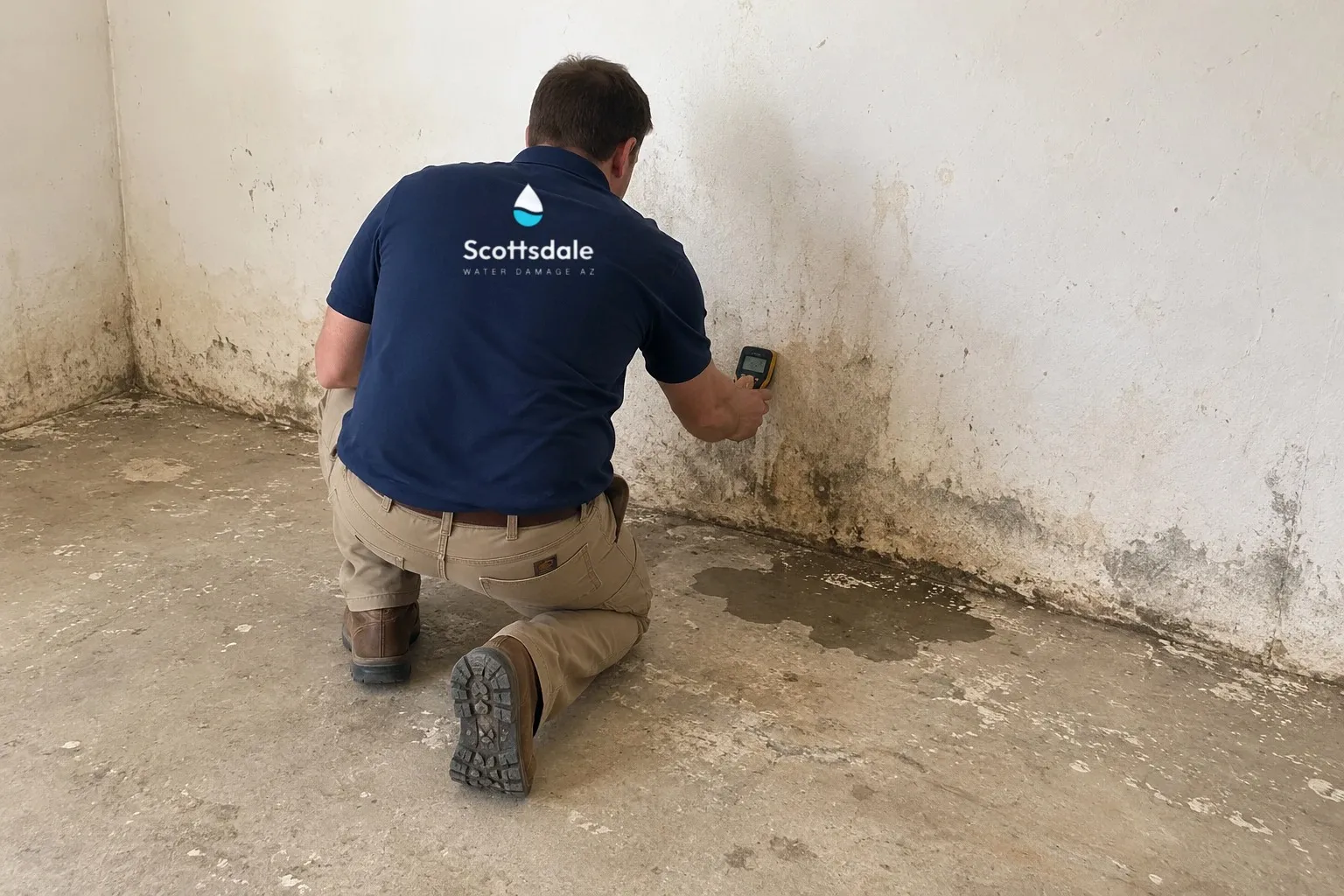
If a restoration company does the drying, ask for copies of its photos and moisture readings. Moisture readings are measurements of how wet walls and floors are. You can share them with your insurer.
Keep everything in one folder, on paper or on your phone. Your adjuster may ask for it later.
How common and how costly are water damage claims?
According to Triple-I, about 1 in 60 homes with insurance has a property damage claim caused by water damage or freezing. From 2019 to 2023, those claims averaged $15,400.
Among causes of property damage, only fire and lightning claims averaged more. The 1 in 60 figure comes from 2018 to 2020 data. Both numbers are national.
Numbers like these are a good reason to read your policy now, before anything leaks. Find the sections on water, flood, sewer backup and mold. Note your deductible, the part of a loss you pay yourself.
If water is in your home right now, stop it and take photos first. Then call now about water damage restoration in Scottsdale. For other topics, see more water damage guides.