The fastest way to limit water damage is to stop the water, and many people look for their shutoff for the first time while standing in an inch of it. A few minutes of looking today can save a lot of damage later.
Where the main shutoff usually is in a Scottsdale home
The main valve is usually where the water service pipe enters the house from the street. Check the outside wall on the street side, the garage, and the utility or laundry room first.
In most homes, the main valve sits in one of these places:
- On the outside wall where the supply line comes in from the street.
- In the garage, along an interior wall.
- In a utility or laundry room, often near the water heater.
- In a ground level box near the street, on the meter side.
- In a closet on the side of the house that faces the street.
If you do not know which one is yours, walk around the house and find where the water service pipe meets the wall. The valve is almost always there or just inside. Once you find it, tag it, check that the handle turns, and show everyone in the house where it is.
The meter marks where your side of the plumbing begins. Scottsdale city code makes owners responsible for leaks on their side of the meter, including the water lost. So a leak anywhere between the meter and your fixtures is yours to stop.
Not sure who supplies your water? Your water bill names your provider. The Town of Paradise Valley, for example, lists four water providers, and which one serves a home depends on its address.
How to turn off a gate valve and a ball valve
A gate valve has a round handle: turn it clockwise until it stops. A ball valve has a lever: give it a quarter turn, so the lever ends up across the pipe.
Two types of valve matter:
- Gate valve. It has a round handle and closes slowly. Turn it clockwise until it stops. That can take several full turns.
- Ball valve. It has a lever handle and closes with a quarter turn. When it is closed, the lever sits perpendicular to the pipe.
Do not force a stuck valve. A valve that has not been moved in years can break if you put your weight on it, and a broken valve means water you now cannot stop. If it will not budge, the meter is the next place the water can be stopped.
If the problem is on the street side or at the meter, Scottsdale Water customers can call the City at 480-312-5650. In Fountain Hills, the Town lists EPCOR Water at 800-383-0834 to report an outage or other water trouble. If you are not sure who supplies your water, check the company named on your bill.
Fixture shutoffs: stopping one leak without shutting off the whole house
Most fixtures have their own small valve. Closing it stops a local leak and keeps water running in the rest of the house.
Common spots for these valves:
- Under every sink: two small valves, one for hot and one for cold
- Behind every toilet, near the floor or the wall
- Behind the washing machine
- At the water heater, on the cold water pipe that feeds it
- Behind the refrigerator, if it has an ice maker line
- At the irrigation manifold outside
These small valves are often called angle stops. Turn them gently. Old ones can fail when they are forced or turned too far.
A slab leak is different. The pipe runs under the concrete floor, so there is usually no fixture valve that stops it. Close the main and read about slab leak and burst pipe water damage to see what happens next.
The water heater and the AC: two more switches worth knowing
A water heater has its own shutoff on the cold water pipe that feeds it. Your AC has no water valve, but turning it off at the thermostat stops it from making more condensate.
The water heater. The valve is usually on top of the tank or on the pipe just above it. If the tank has failed, close that valve. Then cut power to the unit if it is electric, or turn off the gas if it is gas, but only if you can do that safely. An IBHS study found that the chance a water heater will leak or burst climbs sharply once it is 5 years old, and 3 out of 4 fail before age 12.
The AC. As your AC cools the house, it pulls water out of the air. That water, called condensate, drips into a pan and runs out through a small drain line. If the line clogs, the pan can overflow into a closet, an attic or the ceiling below. If you see water around the indoor unit, turn the system off at the thermostat.
The EPA advises keeping air conditioning drip pans clean and the drain lines unobstructed. In a place where the AC runs from spring into fall, that drain line works hard.
Knowing where both switches are can matter more than any tool you own.
What to do in the first 10 minutes after you stop the water
Stay away from wet outlets and cords, take photos, and move what you can off the wet floor. Then call about the wet rooms.
In order:
- Stay safe around power. Keep out of rooms where water is near outlets, cords or the electrical panel. Ready.gov says not to touch electrical equipment if it is wet or if you are standing in water, and to turn off the electricity only if it is safe to do so.
- Take photos and video. Record the water, the source and every affected room before you move anything. Your insurer may ask for them.
- Move things off the floor. Lift rugs, electronics, papers and small furniture out of the water.
- Think about the kind of water. If it came from a clean supply line, opening the area up and running fans and a dehumidifier helps it dry. If the water is dirty, such as a toilet overflow or storm runoff, hold off on fans. The EPA says not to use fans before you know the water is clean or sanitary.
- Call. Say where the water came from, which rooms got wet and whether the water is clean.
Time matters here. The EPA says to dry water-damaged areas and items within 24 to 48 hours to prevent mold growth.
What not to do
Do not force a stuck valve, cut into a sagging ceiling, or wait for a wet floor to dry on its own.
- Do not count on a shop vac for a big job. A shop vac can help with a small spill of clean water. With a large amount of standing water, it may not keep up, and you can end up moving water around the room.
- Do not cut or drill into a swollen ceiling unless the bulge is small, easy to reach and away from wiring. If the ceiling sags, leave the room. The guide to ceiling water damage covers this step by step.
- Do not close up or paint a wet wall. A wall or ceiling closed up wet can grow mold behind the new paint.
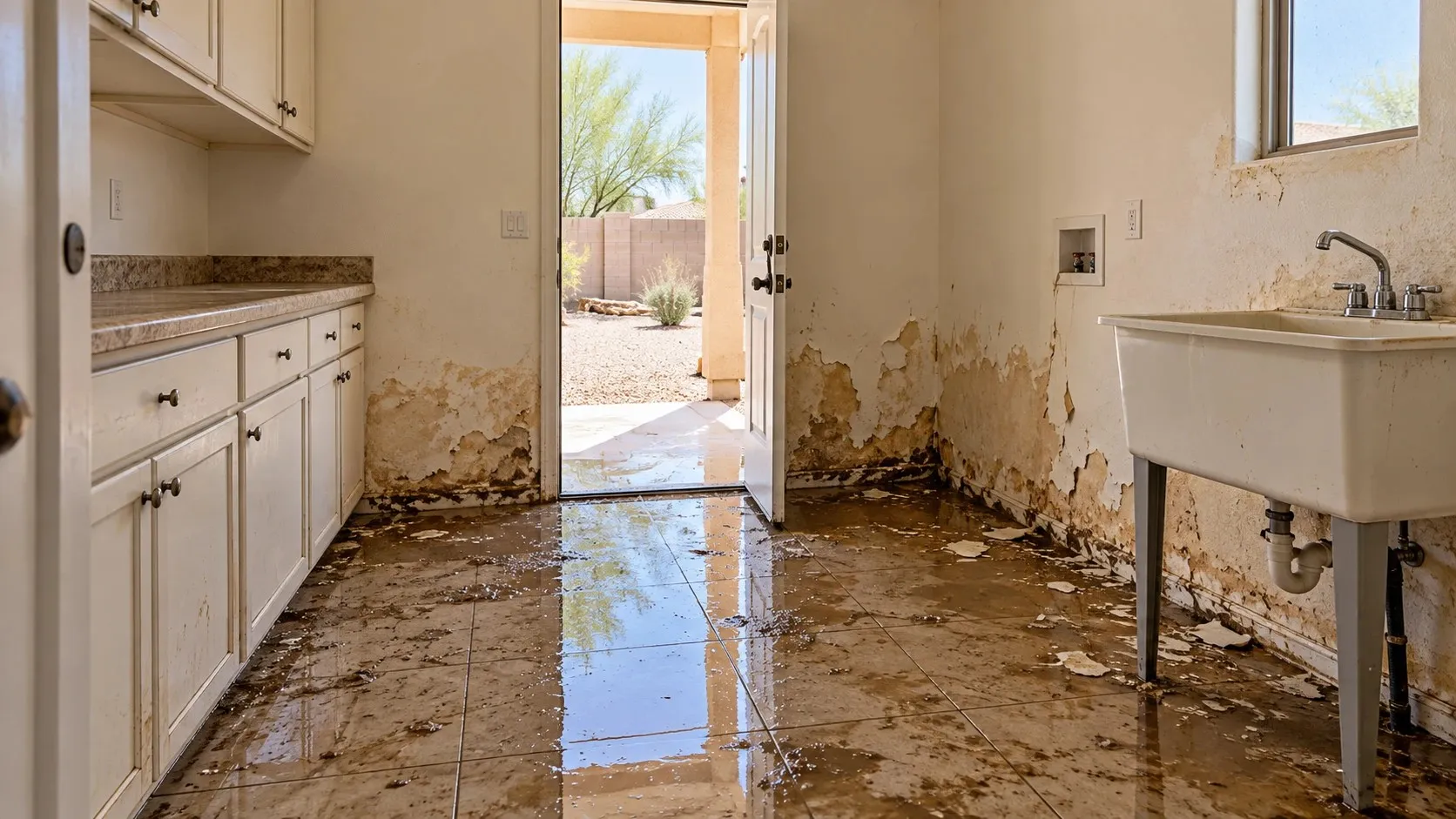
- Do not wait to see if it dries on its own. In a desert house, the surface can look dry while the material behind it stays wet. Dry outdoor air does not dry a wet wall cavity. That is how a small leak turns into a mold job.
After the water is off
Shutting the water off stops new damage. The water already in the floors and walls still has to come out, and someone has to measure how far it traveled.
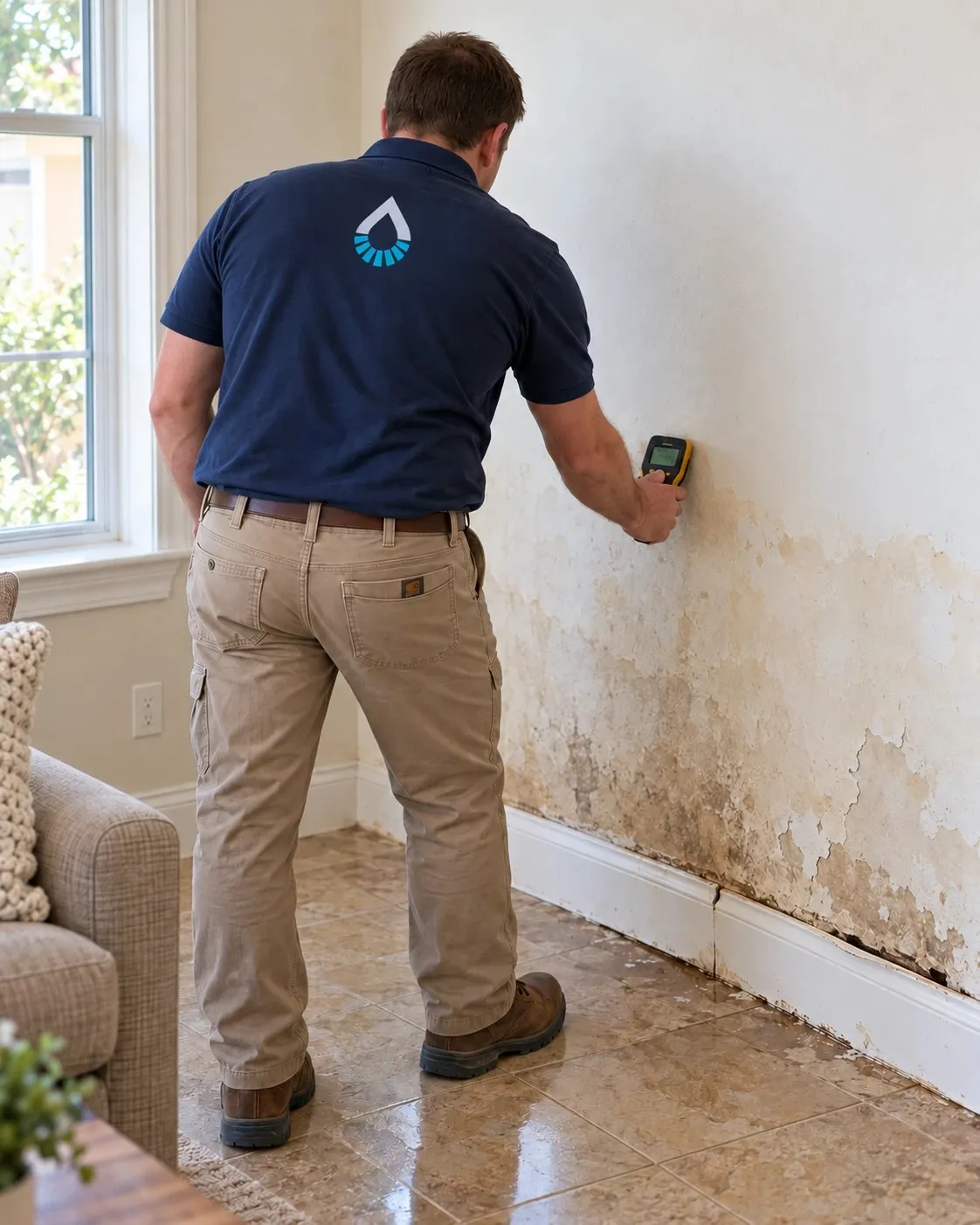
Water spreads under flooring, into the bottom of walls and inside cabinet bases. Moisture readings show where it went, which sets the scope of the work before anyone quotes a price.
The usual order:
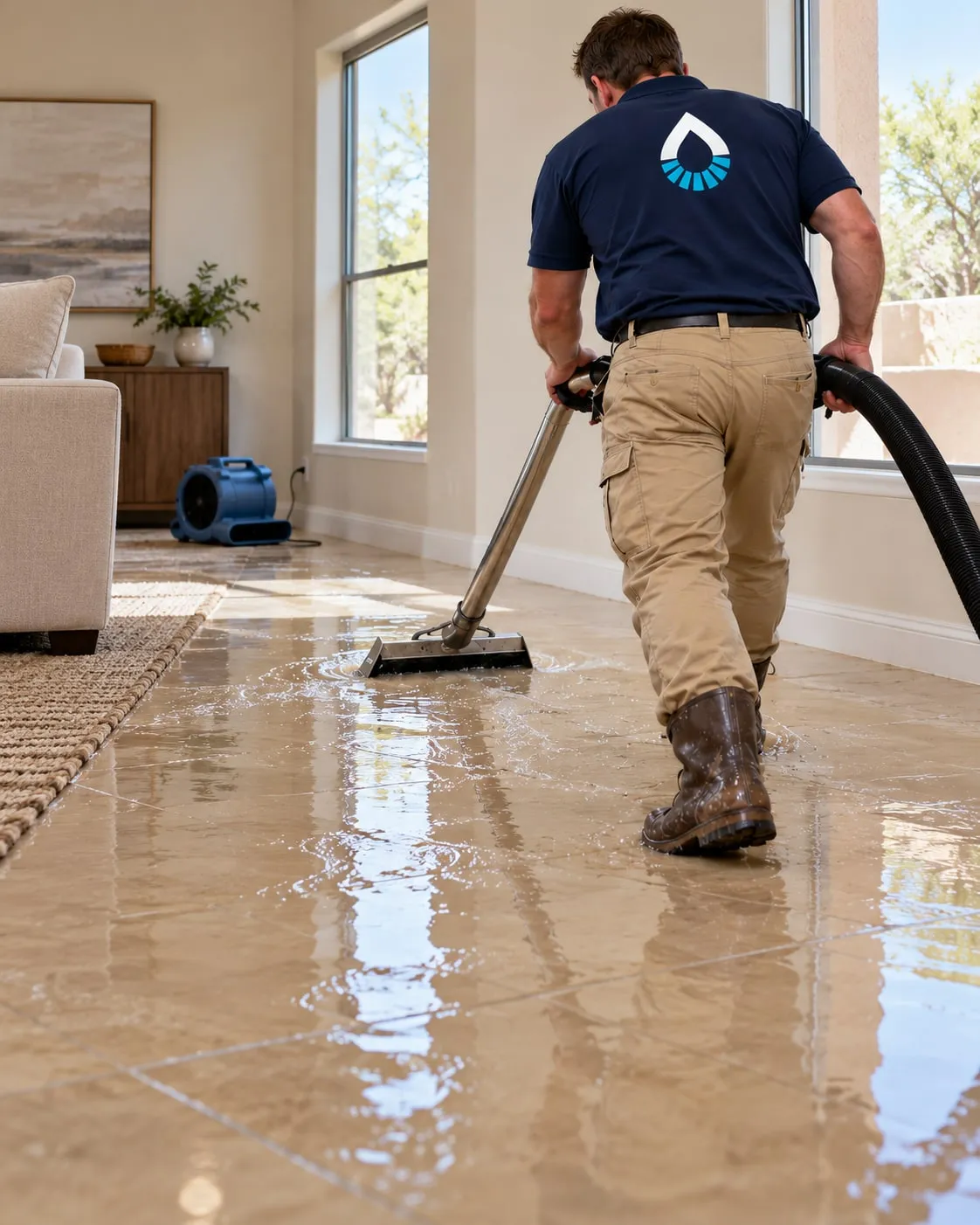
- Remove standing water. Pumps and extraction vacuums pull water off floors and out of carpet. See how emergency water extraction works.
- Measure and dry. Meters find water you cannot see, and fans and dehumidifiers dry the structure until the readings say it is dry. This is called structural drying. Restoration companies commonly quote 3 to 5 days for it.
- Repair. Removed drywall, baseboards and flooring go back in last.
Call and describe what you see: where the water came from, which rooms got wet and how long it ran.